
Evaluate an AI feature by asking what it does, which information it uses and how a person checks the result. A polished answer or demonstration does not establish accuracy for your records. Start with a narrow task and a review process before considering wider use.
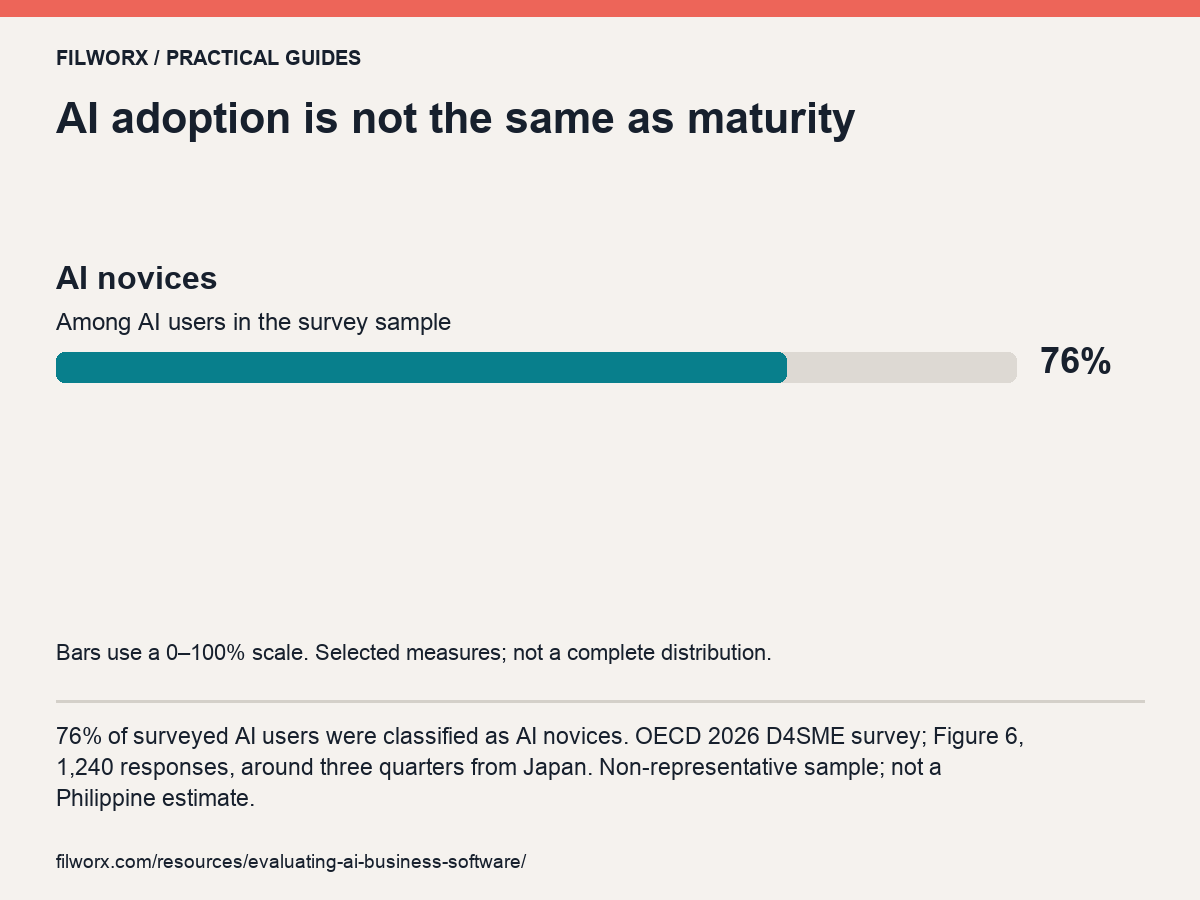
76% of surveyed AI users were classified as AI novices. OECD 2026 D4SME survey; Figure 6, 1,240 responses, around three quarters from Japan. Non-representative sample; not a Philippine estimate.
What recent research adds.
The 2026 OECD D4SME survey classifies 76% of surveyed AI users as AI novices. This supports asking about depth of use rather than treating adoption as evidence of mature implementation. The sample is non-representative and is not a Philippine benchmark.
Test the boundary, not only the successful answer.
An AI evaluation should include conditions where the feature ought to ask for more information or require a person to check the result. A successful response to a clean sample is only one observation. It does not establish an accuracy rate across your business records.
Agree on the acceptable behavior before running each test. Keep a record of the prompt, approved sample inputs, observed output and review decision. A repeatable set of cases makes a later product change easier to reassess.
| Test case | Behavior to examine | Human check |
|---|---|---|
| Known answer | Does the response match the approved source record? | Verify the period, amount or cited passage. |
| Incomplete record | Does the feature identify missing context? | Reject a conclusion that relies on invented inputs. |
| Ambiguous request | Does it clarify scope or explain uncertainty? | Confirm what the user intended before acting. |
| Potential record change | Is the feature read-only or able to take an action? | Check permissions and the required authorization. |
Define the task and its boundaries.
Ask the provider to name the input, output and intended user. Distinguish information retrieval, explanation, document extraction and actions that change records. Confirm which capabilities are available today, which require a selected package and which are only planned.
The NIST AI Risk Management Framework is a voluntary reference for considering AI risks. It can inform evaluation questions, but citing it does not show that a product is certified, compliant or suitable for your use.
Ask what information the feature can access.
Use fictional or properly sanitized records during evaluation. Ask what data is sent to any external provider, who can access the output and what retention or deletion controls apply. Request documentation instead of inferring privacy practices from a demo.
- Which records and fields can this feature read?
- Can it create or change records, or is it read-only?
- Which provider processes the request?
- What access controls and activity records are available?
- How are retention, deletion and user permissions handled?
Test a small set of representative cases.
Choose examples with a known expected result, an incomplete input and an ambiguous question. Check whether the feature identifies missing context and whether a reviewer can trace the response to source records. Record errors and unresolved questions alongside successful results.
For extracted receipt information, compare the output with the original document before accepting it. For an answer about a financial balance, verify the period, source records and filters. Do not treat fluent wording as proof that the result is correct.
Keep the decision and rollout explicit.
Use the HRIS selection checklist for broader workflow questions and the software-readiness checklist for ownership, training and a limited pilot. Decide which tasks still need human review and who handles a questionable result.
Review current FilWorx product scope in a demo. AI assistance is available in selected HR and accounting packages; availability should be confirmed for the proposed setup. Do not assume the same capabilities across products or rely on a planned feature as an available one.
Sources & further reading.
Further reading from the original publishers. Product documentation describes that publisher’s product; it does not establish FilWorx capabilities.